We explored three dimensions of Wikispeedia navigation: the structure of Wikipedia’s link graph, player navigation behavior, and how graph size and restrictions affect success.
-
Graph structure: Links are heavily concentrated at the beginning of articles, especially in the lead, with another cluster near the end, resulting in a highly skewed distribution. Restricting links too aggressively makes navigation infeasible, but the lead section alone retains much of the graph’s connectivity due to redundant links. The network is hierarchical, with geographic articles as authorities and list-like pages as hubs. Full navigability depends on access to many links per article, reflecting strong structural redundancy.
-
Player behavior: Articles with many incoming links attract more clicks and align with graph-defined authorities. Players typically follow a hub-first, then narrowing strategy, relying heavily on early-positioned links. Most successful paths use only a limited portion of available links, indicating that deep exploration within articles is rare.
-
Graph size and restrictions: The analysis of different subgraph constructions relies on paths generated by a pretrained model that approximates human navigation behavior. While the model captures key player tendencies, results should be interpreted comparatively. Smaller graphs produce shorter paths but sharply lower completion rates, while larger graphs provide redundancy and alternative routes that substantially improve success. Strong link restrictions remove critical shortcuts, leading to fast but largely unsuccessful navigation and showing that there is no better smaller graph.
So what does all of this say about how a Wikispeedia player would navigate the 2025 version of Wikipedia?
Players do not appear to develop fundamentally new strategies on subgraphs, so we believe that it will be the same on a bigger version of wikispeedia. If Wikispeedia were played on today’s Wikipedia, players would benefit from a larger and denser link structure that would make success easier. However, it would probably take people more time to complete a game. That said, all of these should be taken with a grain of salt. This analysis relies on paths generated by an AI model, which is only an approximation of human behaviors.
Here is the structure of the website!
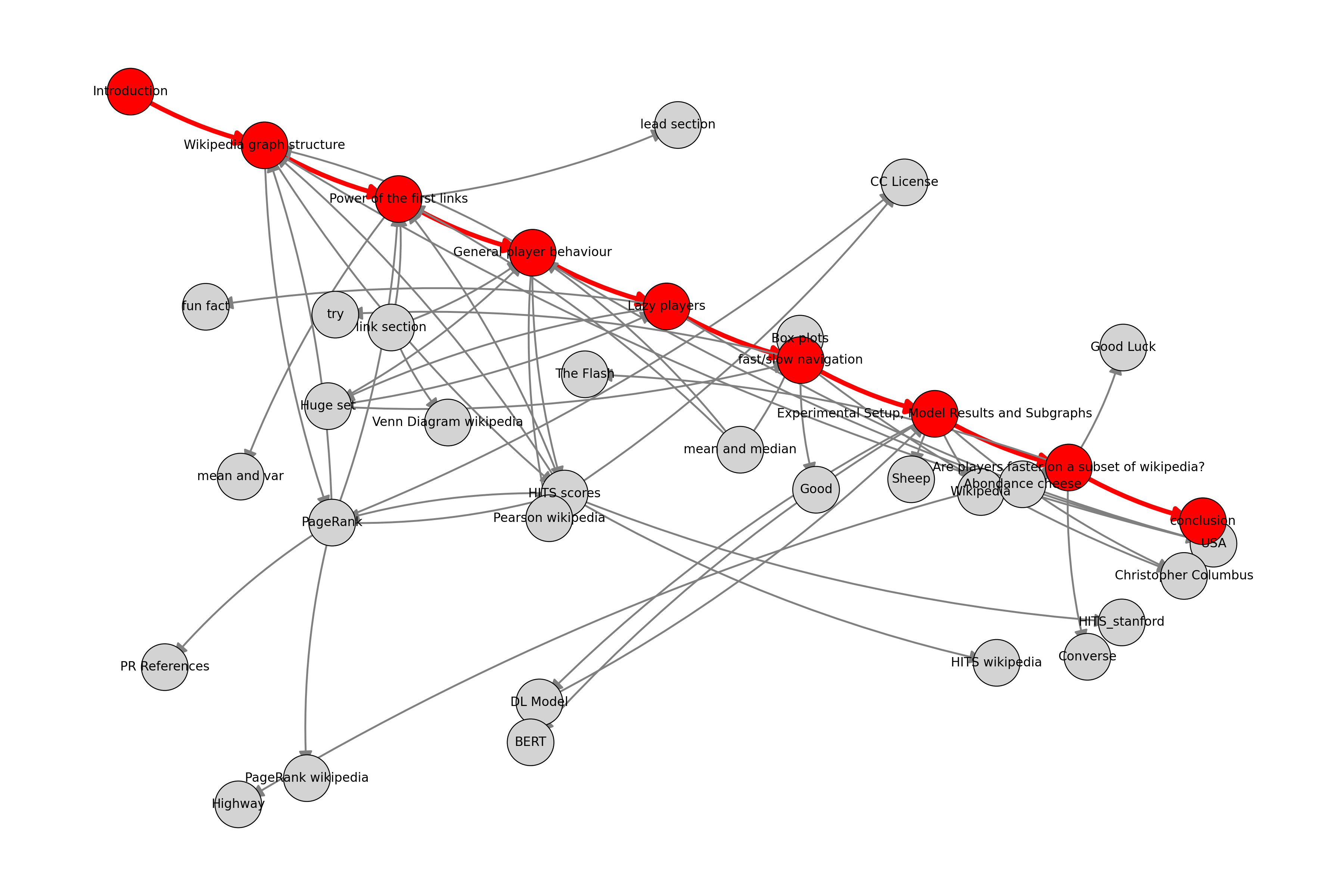
And if you want to look at the bonus links (Not ordered):
- BERT
- The model
- A fun fact
- HITS
- A huge set
- An upset plot
- Mean and Median
- try
- PageRank
- Wikipedia
- Good
- navigation
- deep learning model
- BERT
- abundance
- Conversely
- most popular choices
- More links to other websites were included like papers, wikipedia pages etc.